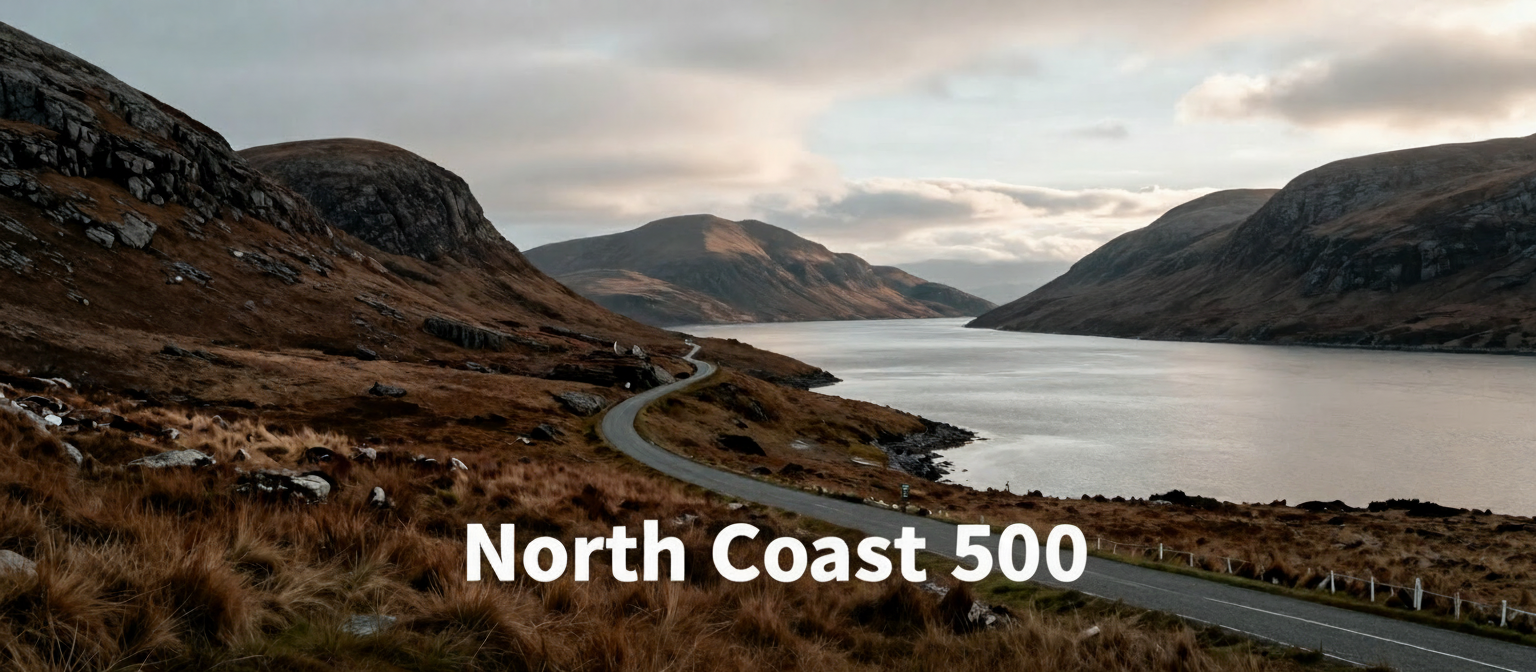
A flexible seven-day starting point for a North Coast 500 adventure. Treat this as a rhythm, not a race: weather, road conditions and curiosity should all have a say.
Seven days is enough to see the shape of the North Coast 500, but only if you are willing to be selective. The route is long, the roads are slow and the best moments tend to arrive when you pull over, not when you press on. Think of what follows as a rhythm to borrow rather than a timetable to follow. Some days are for driving, some are for walking, and some are for doing very little at all.
Before you set off
Spend a little time on the practical things in Inverness, because the quiet stretches start soon after you leave. Fill the tank, check your tyres and stock up on snacks, water and a flask. Download offline maps, because mobile signal is patchy in many places. If you haven't already, book your accommodation for the whole trip, since the best places fill early in the season.
Then plan lightly. Choose one or two things each day that you really want to do, and treat everything else as a bonus.
Days 1–2 · Inverness to the west coast
Leave Inverness and head west, and notice how quickly the scenery changes. The first day is as much about getting into the mood of the trip as covering miles, so keep the plan simple.
Your first night is best spent around Applecross or nearby. How you get there depends on your vehicle and the weather. The Bealach na Bà is the famous route over the hills, with steep gradients and tight hairpins, and a fine experience on a clear day for confident drivers in a suitable vehicle. It is not recommended for learner drivers, caravans or large vehicles, and it is not a road for poor visibility. The alternative route round the coast via Shieldaig is longer and gentler, and it is lovely in its own right.
On day two, continue north towards Gairloch. The coast here is a mix of sheltered bays, rocky headlands and wide beaches, with views across the water to Skye and the Outer Hebrides on a clear day. Big Sand and the beaches near Redpoint reward a slow morning, and the gardens at Poolewe are worth the detour if you want somewhere sheltered when the weather turns. Book your accommodation before you travel, and leave room for a slower start than you planned.
Days 3–4 · Ullapool and Assynt
Make Ullapool your practical reset. It is one of the larger settlements on the route, with shops, food and fuel, so it is a good place to restock and check the forecast for the days ahead. On the way, Corrieshalloch Gorge near Braemore is a quick and dramatic stop. If you have time and energy, the Achiltibuie road is a long, winding loop with views of the Summer Isles, and it suits those who like the quieter side roads.
Continue towards Lochinver and the landscape of Assynt. This is a country of isolated mountains rising from a lochan-strewn moor, and it is unlike anywhere else on the route. Achmelvich Beach is one of the best known beaches on the coast. Clachtoll and the lighthouse at Stoer Head offer more space and more wind. The drive towards Kylesku brings the mountains of Quinag and the long sea lochs into view, and the bridge at Kylesku makes a satisfying landmark.
A full mountain walk needs its own day and should never be squeezed between long driving legs. If you are tempted, plan for it, check the weather and be honest about your experience. A low-level walk and a good lunch can be just as memorable.
Day 5 · The northwest corner
Head towards Durness, stopping only where parking is safe. This is the most remote and, for many, the most beautiful stretch of the route. The road crosses wide open moor, passes lonely lochs and eventually drops down to the sea.
Smoo Cave and the beaches around the village make a good focus for the day. Balnakeil has a long sweep of sand backed by dunes, and Ceannabeinne is a quieter, sheltered bay a few minutes away. If you want to go further, the passenger ferry across the Kyle of Durness for Cape Wrath runs on a seasonal basis, so check the current times and conditions before you plan around it.
The north coast is exposed. Have an indoor or low-level alternative ready in case the weather closes in. A café stop, a gallery or a short coastal walk can salvage a wet day.
Days 6–7 · Across the north, down the east
Travel east through Tongue and towards Caithness. The causeway over the Kyle of Tongue is one of the finest views on the route, with the peak of Ben Loyal behind it. Castle Varrich is a short walk from the village. Further on, Bettyhill has a museum of Strathnaver's history and a beautiful beach at Farr.
The land flattens as you reach Caithness, and the skies seem to open up. Choose between extra coastal time and a visit to Duncansby Head, with its cliffs and sea stacks, which is a short drive from John o'Groats. Dunnet Head, the most northerly point on the British mainland, and the Castle of Mey are other good options if you have the time.
Then continue south through Wick and the east-coast towns. The Grey Cairns of Camster are an atmospheric stop on the way, and the Whaligoe Steps near Wick are a surprising reward for those who like quirky places. Dunrobin Castle near Golspie can anchor your final day before the return to Inverness. Check opening times and build in a margin for your return journey, because the last day is a long one and few people want to rush the end of a trip like this.
If you have more or less time
- With an extra day or two, add a second night in Ullapool, Lochinver or Durness. A single rest day in the middle of the trip changes its whole character.
- With one fewer day, cut the Achiltibuie loop and a detour or two in the north. You'll still see the best of it, though more of it will be through the windscreen.
- With bad weather, swap the walks for the museums, galleries, cafés and castles, and save the best views for the clear days.
Make it yours
This itinerary is not a turn-by-turn driving route. Use the interactive map to shortlist stops, then check road directions, travel times and current local advice. Use the trip planner to build your itinerary. If seven days feels rushed, remove a detour or add another night. The best memories are rarely the ones on a timetable.